
In short: a type test report proves the design; only routine tests, ideally witnessed, prove the units you are paying for. Agree the test plan first, match every serial number, check calibration certificates, watch the partial discharge and withstand tests, and release payment only when every hold point is closed.
Gas-insulated switchgear (GIS) is one of the largest single purchases a power utility or mine in Southern Africa will make. Once it is energised at 132 kV, 330 kV or 400 kV, a hidden factory defect can take a substation off the grid. This guide explains what an independent inspector checks when witnessing GIS tests in China, based on our own work in a high-voltage test hall for a client.
What we were doing in the test hall
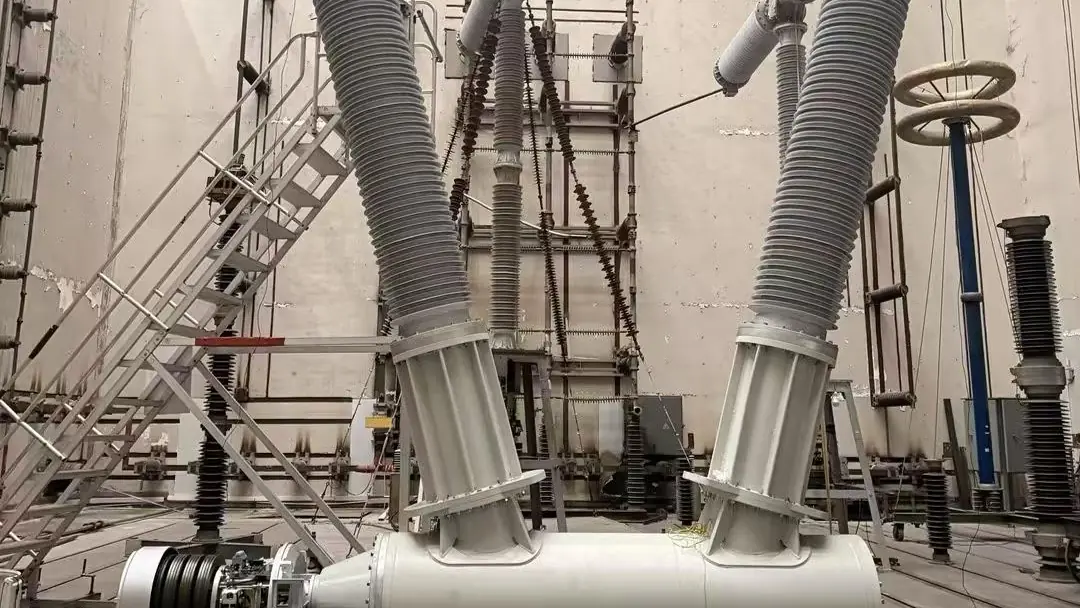
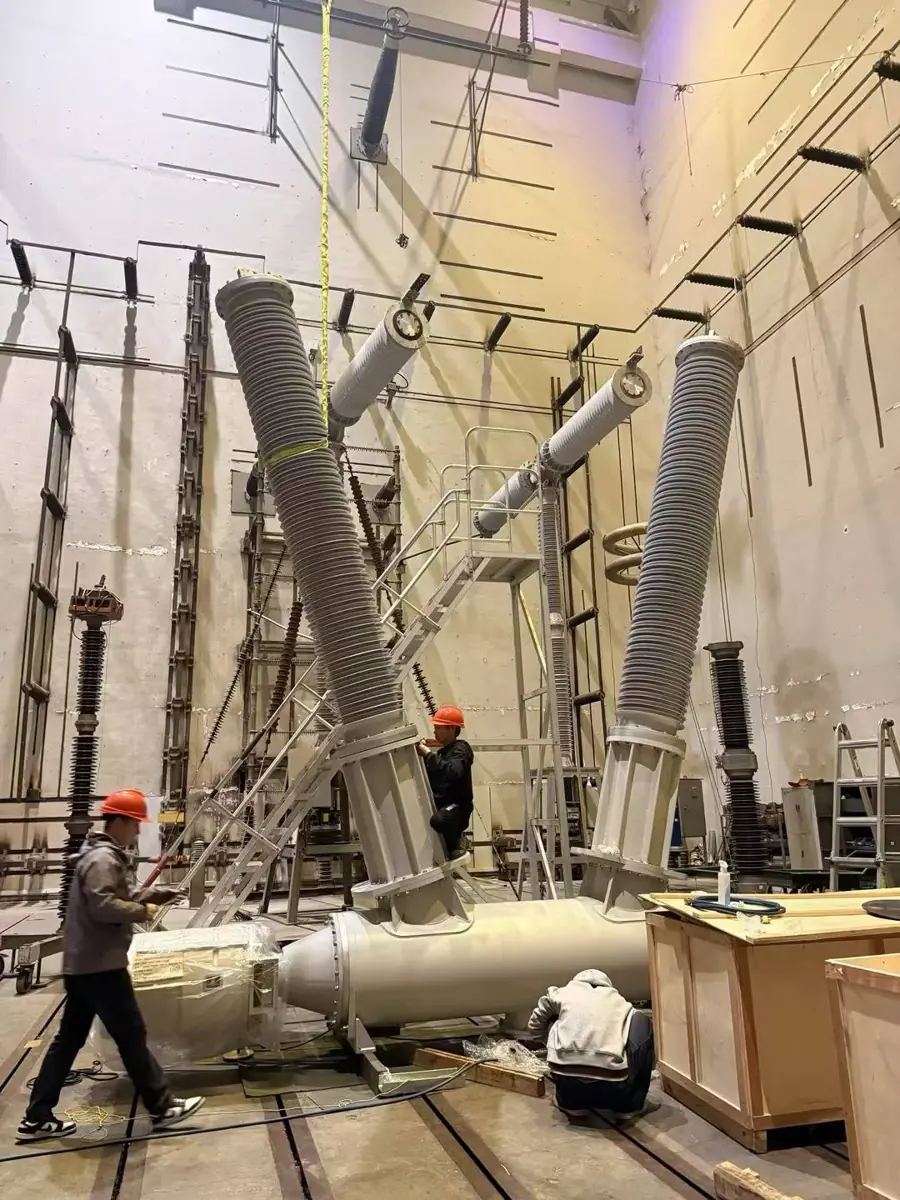
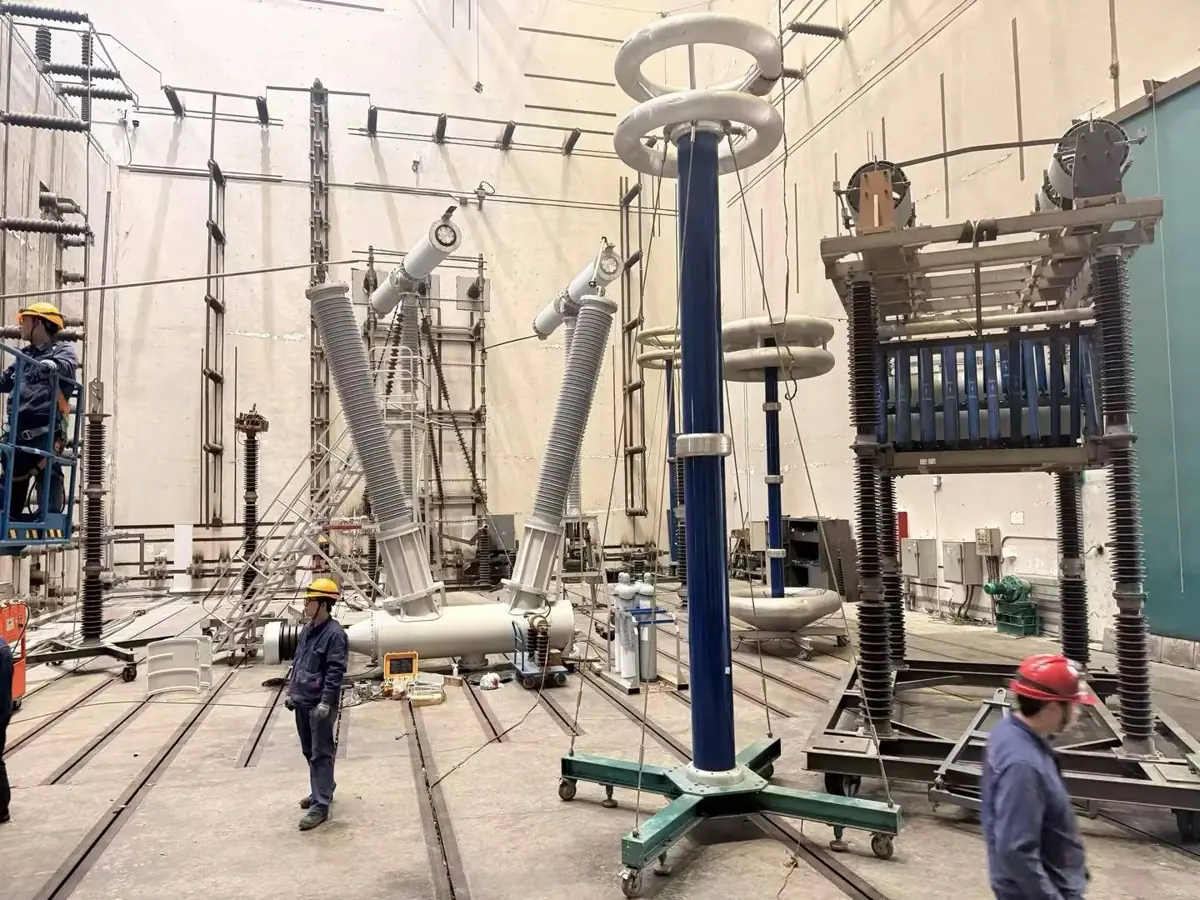
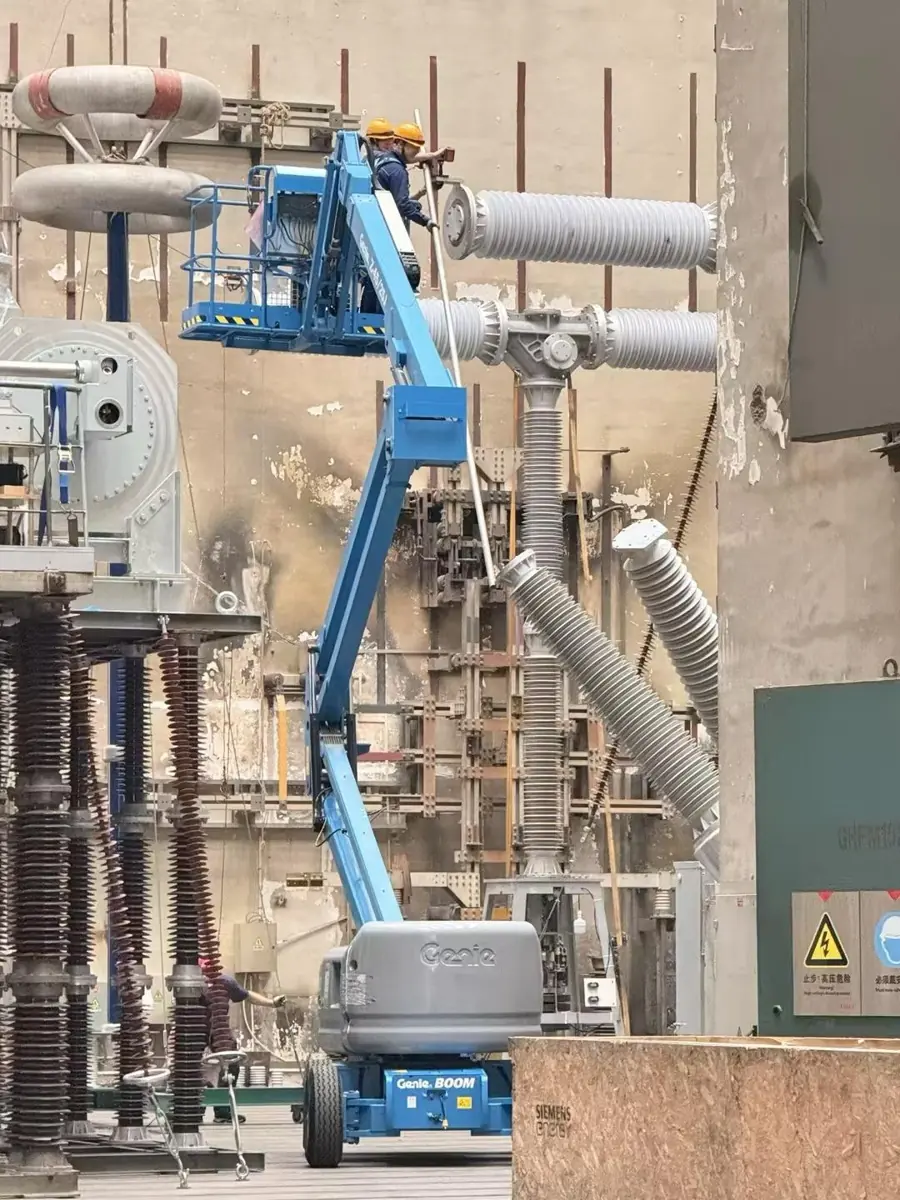
A client buying high-voltage gas-insulated switchgear from China asked Africa Opal to attend the testing on their behalf. Our role was to be the buyer's eyes in the room: confirm that the equipment under test was the equipment ordered, that the tests followed the agreed plan and standards, and that the results in the final report matched what we saw. The photos on this page were taken during that work. We do not name the client, the manufacturer or the laboratory. More photos are on our field work page.
Type tests and routine tests
The international product standard for GIS above 52 kV is IEC 62271-203. The current version is the 2022 edition (Edition 3.0), which replaced the 2011 edition. It splits testing into two groups.
- Type tests prove that a design meets its ratings. They are done once on a representative unit, usually at an accredited high-voltage or high-power laboratory. Typical type tests are lightning impulse, switching impulse (for rated voltages above 245 kV, that is 300 kV and above), short-time current, temperature rise, internal arc and mechanical endurance.
- Routine tests prove that each unit built is free of manufacturing defects. They are done on every bay or transport unit, usually in the factory test bay: power-frequency withstand, partial discharge measurement, main circuit resistance, gas tightness, mechanical operation and auxiliary circuit checks.
Never accept a type test report on its own as proof that the units being shipped are sound. The type test proves the design. Only the routine tests say anything about the specific units you are paying for.
Our witness checklist
No standard publishes a single witness checklist, so the list below is our practice, built on the requirements of IEC 62271-203, IEC 62271-1 and IEC 60060-1.
- Agree the inspection and test plan before travelling. It should list each test, the standard and edition it follows, acceptance values, and which steps are hold points (testing stops until the witness is present). A plan that still cites the 2011 edition of IEC 62271-203 should be queried.
- Confirm the identity of the test object. Match bay and component serial numbers (circuit breaker, disconnectors, earthing switches, instrument transformers, bushings) to the purchase order and drawings. Photograph every nameplate: rated voltage, rated current, short-circuit current, gas type and rated filling density.
- Check calibration of the measuring equipment. Voltage dividers, the partial discharge calibrator, the micro-ohmmeter, timing analyser, gas leak detector and gas moisture and purity analysers should each have a current, traceable calibration certificate.
- Watch the partial discharge test closely. Partial discharge (PD) reveals free metal particles, voids in spacers and poor assembly. Record the background noise level and the calibration pulse before testing, and the PD value in picocoulombs (pC) per compartment. A limit of 5 pC is common in GIS specifications, but the contract sets the figure, so confirm it in advance.
- Record the power-frequency withstand test. Note the applied voltage, frequency and duration, and confirm there was no breakdown. Record temperature, pressure and humidity, because corrections under IEC 60060-1 apply to insulation in open air, such as the outer surface of the bushings.
- Check the gas. Ask for the gas certificate (new SF6 to IEC 60376, or reclaimed gas to IEC 60480). Witness the moisture and purity measurement after filling, the filling density and the tightness test. Under the 2022 edition, the type-test leakage limit for gases with a global warming potential above 1 000, such as SF6, is 0.1 percent per year per compartment, down from 0.5 percent.
- Witness mechanical operation: operating counts, timing and travel records, operation at minimum and maximum control voltage, interlocks between breaker, disconnector and earthing switch, and density monitor alarm settings.
- Measure main circuit resistance and compare it with the type-tested value and the manufacturer's tolerance.
- Check auxiliary and control wiring against the schematic, including the insulation test on control circuits.
- Sign the raw data on the day. We sign each test record, log any non-conformance and photograph the setup and results. The final report must quote the same serial numbers and values.
- Release only when every hold point is closed. Our release note can be named as a required document in the purchase contract or letter of credit, so the balance is not paid on a report the buyer has not verified.
Laboratory accreditation: what to ask for
Many Chinese laboratories, independent and in-house at manufacturers, advertise accreditation by CNAS, China's national accreditation body for testing laboratories under ISO/IEC 17025. Accreditation is only useful if it covers the test you need. Ask for:
- The CNAS certificate and its scope of accreditation, the annex that lists the standards and tests covered. The certificate alone is not enough.
- Whether the lab is independent or belongs to the manufacturer. An accredited in-house lab can be acceptable for routine tests; for type tests, buyers often prefer an independent laboratory.
- The full type test report, not a summary, and confirmation that the tested design matches the offered equipment: ratings, enclosure, gas and interrupter.
- For short-circuit type tests, whether the results carry certification under the Short-Circuit Testing Liaison (STL), an international group of high-power laboratories. Check any STL claim on the STL website.
Why this matters for buyers in Zimbabwe and the SADC region
Zimbabwe's transmission grid runs mainly at 330 kV, with a 400 kV interconnection. Eskom in South Africa transmits at 220, 275, 400 and 765 kV, with 132 kV for sub-transmission. GIS for these networks is usually bought from overseas, and the buyer rarely has engineers in the factory. At 330 kV and above, the type test report should also cover switching impulse.
CIGRE, the international council on large electric systems, has surveyed GIS service experience several times. The defect types it describes, such as free metal particles, assembly errors, loose contacts and spacer defects, are the faults that factory partial discharge and withstand tests are designed to catch.
SF6 and alternative gases
Most GIS still uses sulphur hexafluoride (SF6), a very strong greenhouse gas. The EU F-gas Regulation (EU) 2024/573 restricts putting new switchgear that uses fluorinated gases into service in the EU in stages, with equipment above 145 kV affected from 1 January 2032, subject to exceptions where no suitable alternative is offered. SADC utilities are not bound by this rule, but manufacturers are moving their product lines, and tenders may receive offers using alternative gases. These need different gas analysers, handling procedures and tightness criteria. A witness should check the gas type on the nameplate and make sure the test methods suit that gas.
Factory witnessing is not the last step
Factory tests catch defects made in the factory. They cannot catch damage in transit or contamination during site assembly. Budget for site high-voltage and partial discharge commissioning tests after installation, and keep the factory results for comparison. We also recommend supervising container loading and checking shock indicators on arrival. For transformers, see our transformer inspection guide.
Frequently asked questions
Can I rely on the manufacturer's own test report for switchgear?
It is a starting point, not proof. A witnessed test lets you confirm that the report describes your serial numbers, that the measuring equipment was calibrated, and that the values were recorded as measured.
Do I need to witness every factory test?
Not always. Many buyers make partial discharge, power-frequency withstand and gas tightness hold points, and review the other tests from records. The inspection and test plan should say which is which.
How much notice does a witness inspector need?
Write at least two weeks' notice of the test date into the purchase contract. Our inspectors are based in China, so we can often attend at short notice.
Do you witness tests on other power equipment?
Yes. We can also witness tests on transformers, cables, generators, solar modules, inverters and batteries, and supervise container loading.
- IEC 62271-203:2022, gas-insulated metal-enclosed switchgear above 52 kV, IEC webstore
- IEC 62271-203:2022 preview: foreword and changes from the 2011 edition
- IEC 60060-1:2025 high-voltage test techniques, edition 4.0 (preview)
- IEC 62271-4:2022, handling procedures for gases, IEC webstore
- National Grid technical specification TS 3.02.14 for GIS
- CIGRE TB 947: fourth international reliability survey (2024)
- Short-Circuit Testing Liaison background, JEMA
- Zimbabwe power sector overview, USEA
- Transmission and distribution of electricity, Eskom
- EU F-gas regulation factsheet, Siemens Energy
This article is general guidance, not legal or customs advice. Rules change; confirm requirements for your product before you order.
Want us to apply this to your next order?
Talk to us on WhatsApp